-
→
🔗 AI, Tools and Transformation, Benedict Evans
Narrowly, that means that the task to be automated might be sitting in plain sight but the people with that task don’t see it. This is what leads to the idea of the ‘forward-deployed engineer’ - someone who is a builder, and knows what AI can build, can ‘just’ walk around a law firm or an architecture office and see the opportunities lying on the table that the lawyer or the architect doesn’t see.
The deeper problem is most of what we’ve automated in the last few decades wasn’t obvious, even if you are a tool-builder, and didn’t have an obvious solution either. We can all think of examples of stuff we use every day where our first reaction was “Why would I want that?” Very often, it’s not obvious that the problem exists, and very often it’s embedded or bundled or hidden inside something else.
-
→
Finished The Magic Mountain by Thomas Mann. Enjoyed it! Making progress on my current ten historical novels reading list

-
→
Watched: The Dark Knight 🍿
-
→
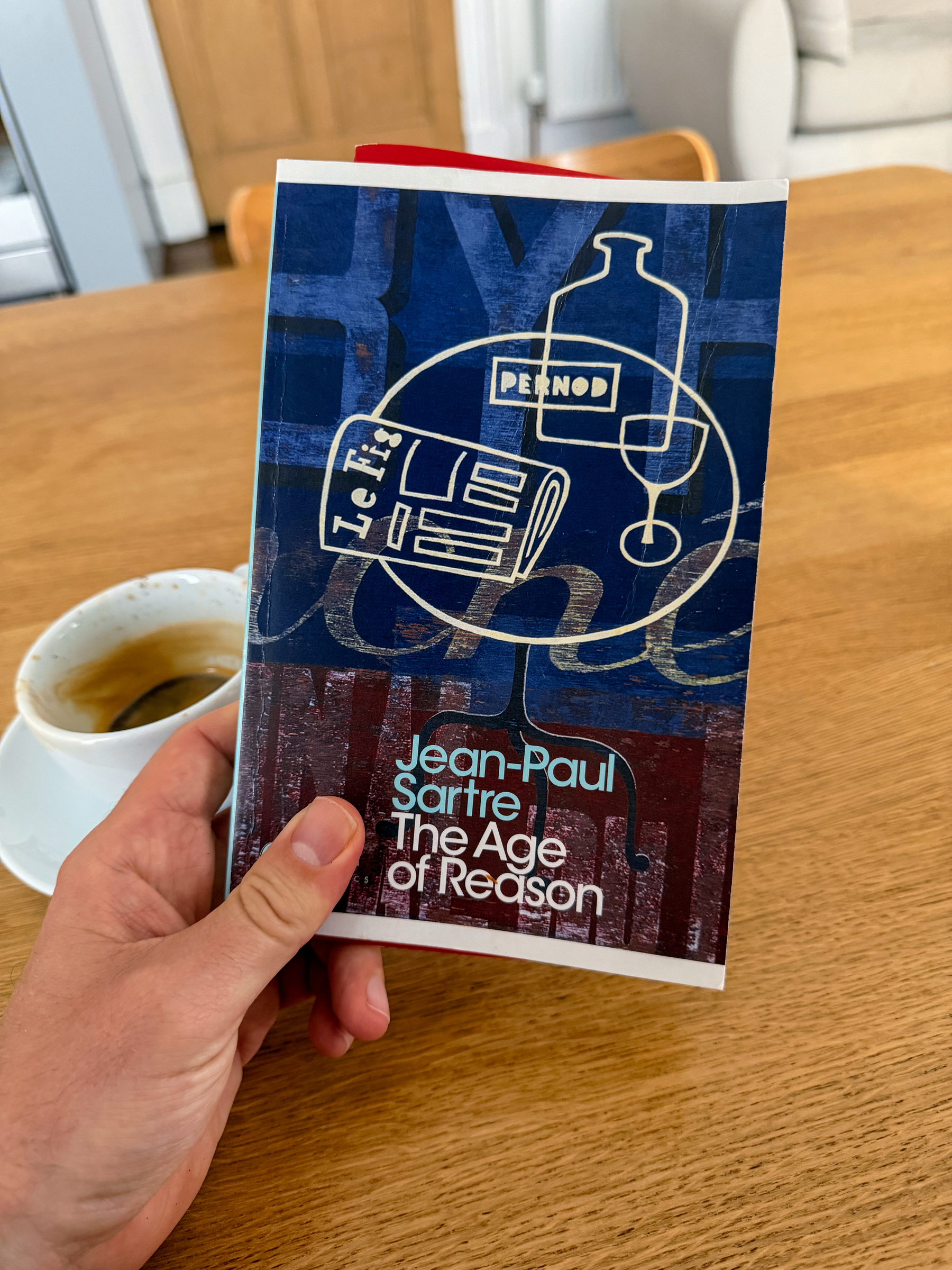
Currently reading: Age of Reason by Jean Paul Sartre 📚
-
→
🔗 Friendship Suffices, L. M. Sacasas
“I do think that if I had to choose one word to which hope can be tied,” Illich once said, “it is hospitality.” In the same context, he also claimed that “if there is something like a political life to be, to remain for us, in this world of technology, then it begins with friendship.” “Therefore my task,” he explained, “is to cultivate disciplined, self-denying, careful, tasteful friendships. Mutual friendships always. I and you, and I hope a third one, out of which perhaps community can grow. Because perhaps here we can find what the good is.”
-
→
Ethan Mollick: Decisions about how to use AI in your organization are increasingly organizational design and strategy decisions, not IT choices: How do you integrate agents into your firm? What intelligence will you outsource? What are the boundaries of the firm? What is the role of people?
-
→
🔗 Everyone Arguing About Whether the Midjourney Scanner Can Replace An…, Matt Schwartz
The Bitter Lesson is simple. AI gets powerful when you feed it raw, unfiltered data and let learning, search, and compute to the work.
-
→
🔗 Agency IS a Virtue, Actually, Dr. Gena Gorlin
The hardest part of “just doing things” is having things you want to do. Figuring out what you want, and integrating your wants so that they amplify rather than inhibit one another, is essential to the kind of decisive action we associate with High Agency. But having clarity on what you want is not something that just happens to you, at least not for long; it is something you need to build and maintain using your agency. And this includes actively and honestly reflecting on your ideas of what is right and good, lest these ideas end up guilting and inhibiting you more than they guide and inspire you.
-
→
A couple of highlights on AI and writing:
🔗 Slop Readers, Jacob Falkovich
Here’s the trick: the substance comes from volition, and the volition, for now, is all human. LLMs can’t write good if you tell them “write something for my catering page”. You’re not giving them any substance, and they won’t bring their own. LLMs write fine enough if you tell them exactly what you want to say and to whom and how, the whole structure of argument and motivation and your personal connection to it. But if you get that far, why let Claude be the only one who hears what you wanted to say? Just publish the prompt.
🔗 We Need a Name for This, Because Armin Is Putting…, Drew Breunig
We need a name for this, because Armin is putting his finger on a problem that’s everywhere: people running their writing through an LLM because they think it makes it clearer, when in actuality it sands off all the detail.
-
→
🔗 Norma Sancho’s on AI and Education
So, the question is not only: “Are students using AI to avoid thinking?” The question is also: “What kind of economy and educational system has made a robot feel more viable, attentive, more dialogic, and more intellectually available than the institution charging students for a degree?” If we want students to think first and use ChatGPT later, then someone has to care about their thinking before ChatGPT enters the room.